
Data foundation
Ingestion + ETL pipeline
High-volume telemetry ingested and cleaned into a structured pipeline — architected for direct connection to real factory data sources.
Case Study — Technomation Insights
How Technomation Insights unified telemetry, KPI tracking, and anomaly signals into a single operational picture — validated end-to-end before real-data deployment.
Client profile
Mid-size manufacturing group, multiple production lines
Pilot type
Validated pre-deployment pilot
Platform
Technomation Insights
Status
Real-data pilots open
01
A mid-size manufacturing group operating multiple production lines was experiencing rising downtime and inconsistent OEE visibility. Leadership needed a clear operational view across shifts. Maintenance needed early warning signals and a simple action queue. Neither was getting what they needed.
02
Technomation deployed a full-stack performance platform to unify telemetry, operations metrics, and anomaly signals into a single system. The pilot focused on delivering usable, role-based insights rather than raw data — validating the complete pipeline from ingestion to action. Prior to real-data deployment, the full stack was validated in a high-fidelity environment mirroring live factory conditions. The entire platform is containerised via Docker, meaning deployment into a real factory environment requires hours, not months.
Data foundation
High-volume telemetry ingested and cleaned into a structured pipeline — architected for direct connection to real factory data sources.
Performance engine
Real-time OEE, availability, performance, quality, downtime, and scrap — computed automatically, no manual reporting.
Intelligence layer
Isolation forest model learns normal machine behaviour and flags deviations early. Machines ranked by risk score so teams always know where to act first.
Decision layer
Separate views for executive, operations, and maintenance — each showing the signals that matter to that role, not everything at once.
Action layer
High-risk machines surfaced with context. Maintenance receives a prioritised queue — not just an alert, but a clear next step.
Deployment
The entire stack — pipeline, API, and dashboard — runs in Docker containers. New environments can be live in hours, not months. No complex on-site installation.
02b
The platform is built in four layers — each with a single responsibility. Raw telemetry flows in at the bottom, gets cleaned and aggregated, passes through the KPI engine, and surfaces through a FastAPI layer to role-based dashboards. No data gets shown to users before it's been validated and computed.
Architecture diagram
Dashboard screenshot
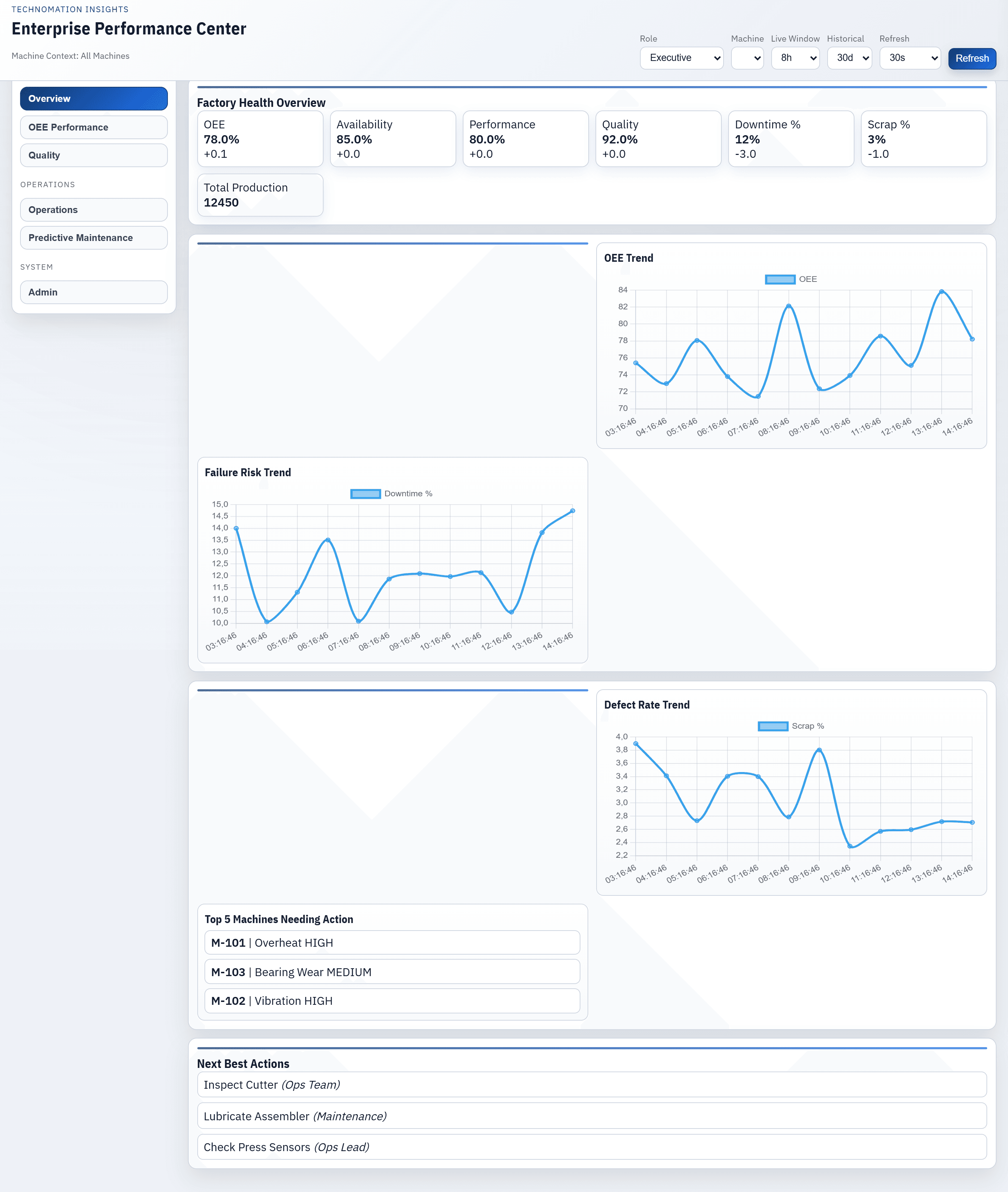
03
Five purpose-built views, each designed for a specific decision context. The goal was not to build one dashboard that tries to serve everyone — it was to give each function exactly the signal they need.
| View | What it shows | Audience |
|---|---|---|
| Overview | Executive KPIs, OEE trend, failure risk trend | Executive |
| Operations | Machine status grid, anomaly signals, risk ranking, active alerts | Operations |
| OEE Performance | Trend analysis and loss breakdown by category | Ops + Executive |
| Predictive Maintenance | Action queue and workflow board by machine | Maintenance |
| Quality | Defect rate, production vs target, trend | Ops + Executive |
04
The pre-deployment validation confirmed the system's ability to detect, prioritise, and communicate operational risk across conditions that mirror a live factory environment.
Isolation forest model detected machine irregularities before they escalated to stoppages — without needing labelled fault data.
The action queue replaced guesswork — maintenance teams knew exactly what to address first.
Exec, ops, and maintenance worked from the same underlying data — different views, shared reality.
Leadership and operations reached the same conclusions faster — without chasing each other for numbers.
The system demonstrates how a manufacturer can reduce downtime by acting on early signals, increase OEE through targeted interventions, and align stakeholders around a shared operational truth — validated end-to-end before a single line of real factory data flows through it.
05
The shift the platform delivers isn't just technical — it changes how teams operate day to day.
Before
Faults discovered after the stoppage — response is always reactive
OEE reported manually, inconsistently, and after the shift ends
Maintenance backlog managed by instinct, not risk ranking
Exec, ops, and maintenance working from different numbers
Data scattered across systems — no single source of truth
After
Isolation forest ML model detects abnormal behaviour before it becomes downtime
OEE computed automatically, in real time, across every line
Action queue tells maintenance exactly what to fix first and why
Three role-based views, one shared operational reality underneath
Single platform from raw telemetry to executive summary
Fully containerised — live in a new environment in hours, not months
We're opening real-data pilots with manufacturers dealing with reactive maintenance, inconsistent OEE reporting, or teams working from different numbers. If that sounds familiar, let's talk.